Which words are capitalised?
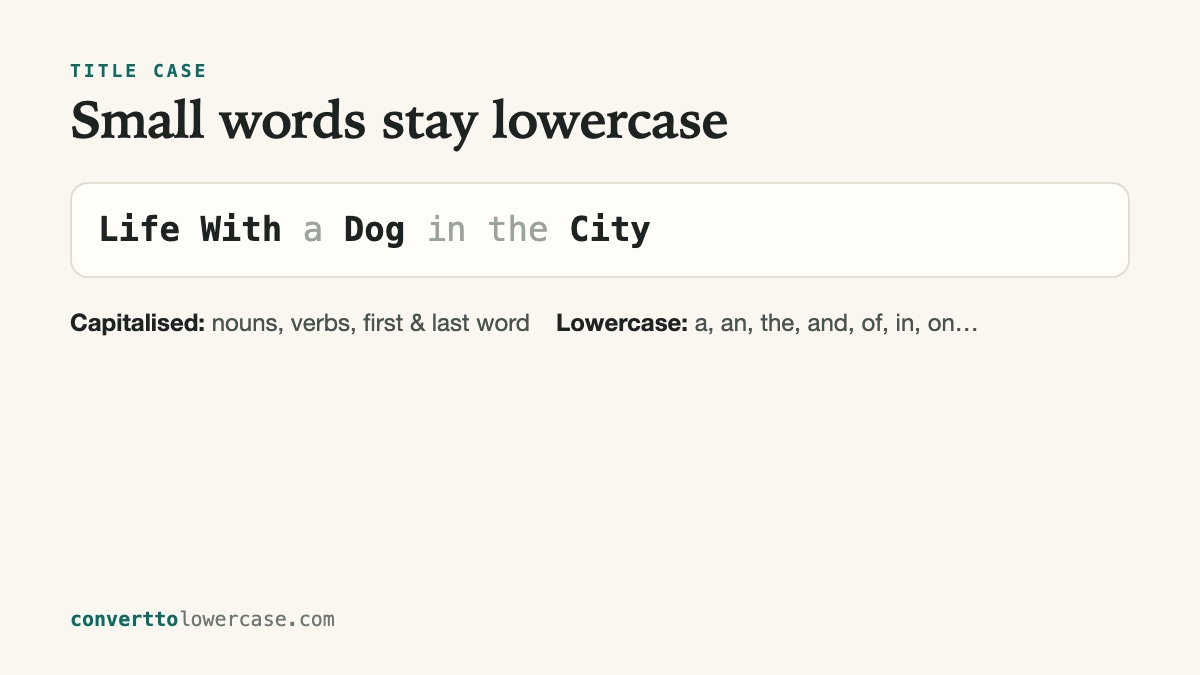
This converter uses a widely accepted middle-ground rule:
- Always capitalised: the first and last word, and the first word after a colon.
- Capitalised: nouns, verbs, adjectives, adverbs and pronouns — in practice, every word that is not on the list below.
- Lowercase: articles (a, an, the), coordinating conjunctions (and, but, or, nor, for, so, yet) and short prepositions (as, at, by, in, of, off, on, per, to, up, via), plus vs.
- Hyphenated words: each part follows the same rules, so “state-of-the-art” becomes “State-of-the-Art”.
Title case styles compared
Style guides disagree mainly about longer prepositions such as “with”, “from” and “about”:
| Style | Prepositions | Example |
|---|---|---|
| AP (news) | Capitalise words of four letters or more | Life With a Dog in the City |
| APA (academic) | Capitalise words of four letters or more | Life With a Dog in the City |
| Chicago (books) | Lowercase all prepositions | Life with a Dog in the City |
| This converter | Lowercase the short ones listed above | Life With a Dog in the City |
If your publication follows Chicago, change a long preposition back to lowercase after converting — or put it in the keep list in lowercase (for example with) and it will stay lowercase.
Title Case or sentence case?
Title Case is traditional for book titles, newspaper headlines and many blogs. Sentence case is increasingly popular for web headings and app interfaces because it is easier to scan. Pick one style and use it consistently throughout a document.
Frequently asked questions
What is title case?
Title case capitalises the first letter of the main words in a title, while short function words such as “a”, “and” and “of” stay lowercase unless they are the first or last word.
Is “Capitalize Words” the same as Title Case?
No. Capitalize Words capitalises every single word, including “and” and “the”. Title Case keeps those small words lowercase.
Does it keep acronyms in capitals?
Text is lowercased before title-casing, so “NASA” becomes “Nasa”. Add acronyms to the keep list to protect them.